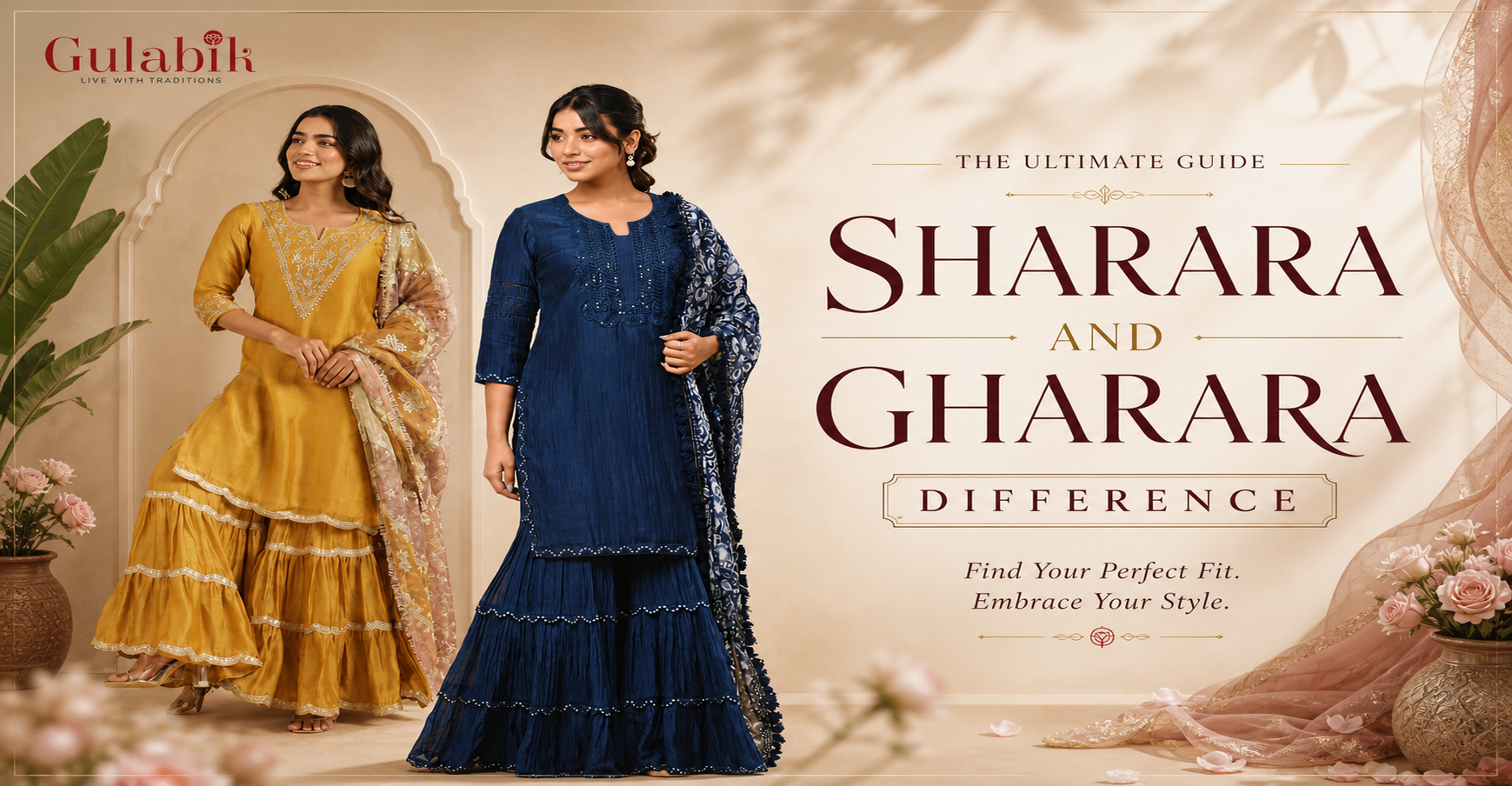
If you’ve spent any time scrolling through fashion feeds lately, you’ve probably noticed that ethnic wear is having a major "renaissance." But we aren't talking about the heavy, stiff outfits of the past. 2026 is all about movement. We want to dance, we want to walk, and we definitely want to breathe. This shift has brought two iconic silhouettes back to the forefront: the gharara and sharara.
I get asked all the time, "Wait, aren't they the same thing?" At a quick glance, sure—they’re both flared trousers. But if you’ve ever bought a gharara thinking it was a sharara, you’ve probably felt that "style shock" when you realized the fit was completely different. Understanding the gharara and sharara difference is the secret to finding an outfit that doesn't just look good on a mannequin, but actually flatters your specific shape.
Let’s break down the geometry of these flares so you can shop with total confidence.
The Structural Blueprint: Defining the gharara and sharara difference
To pick the right one, we have to look at how these garments are actually built. It’s all in where the "drama" starts.
The Seamless Flow of the Sharara
Think of a sharara as the ultimate "skirt-pant." It is a pair of wide-legged trousers that flares out smoothly from the waist all the way down to the floor. There are no seams at the knee, no joints, and no interruptions. When you stand still, a sharara often looks exactly like an A-line skirt. It’s simple, elegant, and has a very modern, minimalist vibe.
The Dramatic Architecture of the Gharara
The gharara is where things get a bit more technical. The gharara and sharara difference is defined by the "knee joint." A gharara is fitted from the waist down to the knees. Right at the knee-line, a massive amount of fabric is gathered and stitched, creating a sudden, voluminous explosion of flare. This joint is usually highlighted by a beautiful lace or embroidered border called the Gota. It’s a regal, vintage look that screams "royal heritage."

Gulabik Deep Gold Garara Set

Gulabik Crimson Garara Set
Selecting the Right Flare for Your Body Type
In 2026, the most stylish thing you can wear is confidence, but a little bit of fashion "math" helps. Here’s how to choose based on your frame.
The Best Choice for Petite Frames: The Vertical Advantage
If you are on the shorter side, the gharara and sharara difference is actually a height hack.
- Go for the Sharara: Since it flows in one continuous line from your waist to your toes, it tricks the eye into seeing a longer vertical line. It makes you look taller.
- The Pro-Tip: Avoid massive flares that might swallow you up. A medium-flare sharara paired with a short kurti is the "golden ratio" for petite women this year.
The Ideal Silhouette for Tall and Athletic Builds: Emphasizing Curves
If you have a tall frame or a lean, straight build, you have the "height budget" to pull off the gharara’s structure.
- Go for the Gharara: The horizontal line at the knee provides a visual break that adds a bit of "oomph" and curve to a leaner frame. The heavy volume from the knee down creates a majestic presence that looks incredible on taller women.
- The Pro-Tip: Make sure the joint hits right at your knee. If it’s too low, it can make your legs look shorter; if it's too high, it looks like it's pulling.
The 2026 Fabric Guide: Matching Material to Motion
Fabric is what makes an outfit move. In 2026, we’re seeing a huge move toward fabrics that feel like a second skin.
- Georgette and Chiffon: These are the "MVP" fabrics for shararas. They have that watery, breezy movement that looks amazing in slow-motion videos.
- Silk and Brocade: These are traditional for ghararas. Because they are a bit stiffer, they hold the ruffles at the knee perfectly, giving you that classic "bell" shape.
- Organic Cotton: This is the breakout star of 2026. We’re seeing a lot of cotton gharara and sharara sets for office wear and daytime events. It’s crisp, cool, and feels very "now."
Expert Styling Guide: How to Wear It in 2026
Once you’ve picked your silhouette, it’s all about the styling.
The Tunic Length Matters
- With a Gharara: Always keep your kurta short. You worked hard to find that perfect knee joint—don't hide it! A mid-thigh length is perfect.
- With a Sharara: You can experiment more. A long, straight-cut kurta gives a very sophisticated, classic look, while a short peplum top feels young and fun.
Why Choose a Gulabik Gharara?
Shopping for ethnic wear online can be a gamble, especially with complex silhouettes like the gharara and sharara. When you browse Gulabik.com, you aren't just buying a suit; you are investing in a garment engineered for the modern woman.
Here is why a Gulabik gharara stands out:
- The "Perfect Joint" Engineering: The biggest flaw in mass-produced ghararas is a knee joint that is either too tight or placed too low, making it impossible to sit or walk comfortably. We spend months perfecting the anatomic placement of our Gota joints so they sit exactly where they should—allowing for full mobility.
- Zero-Bulk Thigh Tailoring: Traditional ghararas can sometimes look bulky around the hips. Gulabik uses a specialized tapering technique that keeps the upper portion sleek, ensuring the focus remains entirely on the dramatic flare below the knee.
- Hand-Curated Jaipur Fabrics: Based in the heart of Rajasthan, we have access to authentic hand-block prints and premium cottons that you won't find in big-box retail. Our fabrics are pre-shrunk and tested for color-fastness, so your favorite set stays vibrant for years.
- Sustainable "Slow" Fashion: We don't believe in "use-and-throw" trends. Every Gulabik piece is made with generous margins and high-quality stitching, intended to be a staple in your wardrobe that you can wear, repeat, and even pass down.
Final Thoughts: Finding Your Flare
At the end of the day, whether you choose a gharara or sharara comes down to how you want to feel. Do you want the seamless, skirt-like elegance of the sharara? Or do you want the bold, architectural drama of the gharara?
Now that you know the gharara and sharara difference, you can stop guessing and start styling. Check out the latest collection at Gulabik.com to find your perfect match. And hey, if you need more styling inspo, come hang out with us on Instagram at Gulabik.jpr.
Frequently Asked Questions (FAQ)
1. Which is more formal, gharara or sharara?
Traditionally, the gharara is considered more formal due to its royal Lucknowi roots. However, in 2026, a silk sharara is equally acceptable for high-end events. It really comes down to the embellishment level.
2. Can I wear a sharara if I have a curvy body type?
Yes! A sharara in a soft, draping fabric like georgette is incredibly flattering for curvy figures as it skims the body without clinging, creating a very balanced, elegant silhouette.
3. What is the "Gota" joint in a gharara?
The "Gota" is the decorative band (often gold or silver) that hides the seam where the flare is attached to the thigh portion. It is the signature aesthetic marker of a true gharara.